Official product information
Phytomem Benefits: Memory, Focus and Clarity Explained
Quick answer
Phytomem is made to support everyday memory, focus and clarity.
These three claims are printed on the front of the bottle. Saffron is the ingredient with small memory trials, while the others were mostly studied for blood sugar or weight.
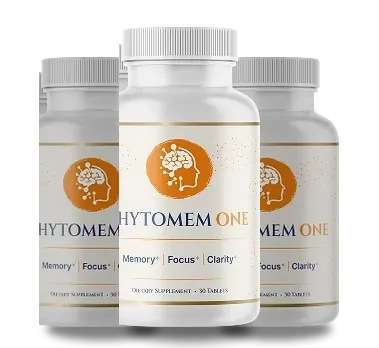
Claims
What benefits does the Phytomem label claim?
The label claims three things: Memory*, Focus* and Clarity*. The sales page adds two longer lines, and all five are general wellness claims, not promises of a measured result.
| Claim | Where it appears | What it means in plain words |
|---|---|---|
| Memory* | Front of the bottle | The product is meant to support normal memory in healthy adults |
| Focus* | Front of the bottle | Meant to support everyday attention, such as staying on a task |
| Clarity* | Front of the bottle | Meant to support a clear-headed feeling; the brand does not define it further |
| "Built for lasting mental clarity, recall, and resilience" | Sales page | A marketing line with no number, test or time frame attached |
| "Support your neurons, neural pathways, and cognitive function" | Sales page | A general support claim about brain cells, not a study finding |
None of these claims names a disease, a score or a percentage. That is by design, and the next section explains why.
Structure
What is a structure-function claim?
It is a claim that a supplement supports a normal body function, such as memory, without saying it treats a disease. The FDA does not review these claims before they are used, which is why they must carry a set warning.
That warning is what the asterisks point to: "These statements have not been evaluated by the Food and Drug Administration. This product is not intended to diagnose, treat, cure, or prevent any disease."
The line between the two kinds of claim matters. The FDA says a product sold to treat, prevent or cure a disease is legally a drug, and the FDA does not approve supplements before sale (FDA, dietary supplement Q&A). So a supplement can say "supports memory" but not "treats memory loss".
Research
What does research say about each ingredient?
Only one ingredient, saffron, has a small set of memory trials behind it. The rest were mostly studied for blood sugar, insulin or weight, and none of these studies tested Phytomem itself.
| Ingredient | Main area studied | What was found | Memory tested? |
|---|---|---|---|
| Saffron extract | Memory in mild cognitive impairment and Alzheimer's | Beat placebo on some scores in 4 small trials; low-certainty evidence (Ayati et al., 2020) | Yes, in people with a diagnosis |
| Fucoxanthin | Weight; one cognition trial | Some memory tests improved over 12 weeks, mostly not clearly versus placebo (Yoo et al., 2024) | Once, from microalgae |
| Fucoidan | Immune response, fatigue | Well tolerated in a few small studies (Fitton et al., 2015) | No |
| Oleuropein (olive leaf) | Insulin sensitivity | About 15 percent better insulin sensitivity in 45 men (de Bock et al., 2013) | One open trial, no placebo |
| Berberine HCl | Blood sugar in type 2 diabetes | Lowered fasting blood sugar and HbA1c across 37 trials (Chen et al., 2022) | No |
| Ceylon cinnamon | Blood sugar | Unclear whether supplements help (NCCIH, cinnamon) | No |
| Four info-page names | Blood sugar, belly fat, weight | Small studies; kudzu flower cut belly fat in 81 adults (Kamiya et al., 2012) | No |
Doses, study sizes and safety for all ten names are on the Phytomem ingredients page, and the thinking behind the mix is on how it works.
Not
What does Phytomem not do?
Phytomem is not a treatment for memory loss, mild cognitive impairment, dementia or Alzheimer's disease. It is a dietary supplement, and it makes no claim to reverse, restore or prevent anything.
- No supplement has been shown to prevent or slow cognitive decline, per a federal health agency review (NCCIH, supplements and cognitive function).
- The FDA has warned companies selling more than 58 products that claimed to prevent, treat or cure Alzheimer's disease (FDA, unproven Alzheimer's products).
- The FTC and FDA have said health claims must be backed by competent and reliable science (FTC and FDA, 2019 warning letters).
- No study of this tablet has been published, so no memory, focus or clarity result can be promised.
Flags
How can you spot a memory claim that goes too far?
Watch for words that promise a cure or name a disease. Federal agencies list these as warning signs, and they apply to any memory product, this one included.
Disease words
A supplement that says it prevents, treats or cures Alzheimer's is making a drug claim. The FDA lists this as a red flag (FDA, false Alzheimer's cure promises).
Miracle language
Words like breakthrough, secret or reverse are sales tools. Real research reports numbers, groups and limits.
Only happy stories
Testimonials and photos of smiling users are not data. This site shows no customer quotes, because none have been verified.
No study to check
If a claim links to no study you can read, treat it with care. The FTC advises asking a health professional before you start any pill (FTC, ask before popping that pill).
By these tests, the three words on the Phytomem label stay inside the rules. The info page's "Type 3 Diabetes" and "Plastic Stranglehold" headings go further in tone, and we explain both on the how-it-works page.
Brain graphic
What does the "Without / With Phytomem One" brain graphic show?
It shows two colored brain images side by side, labeled "Without" and "With" the product. No study stands behind it, so it is marketing art, not evidence.
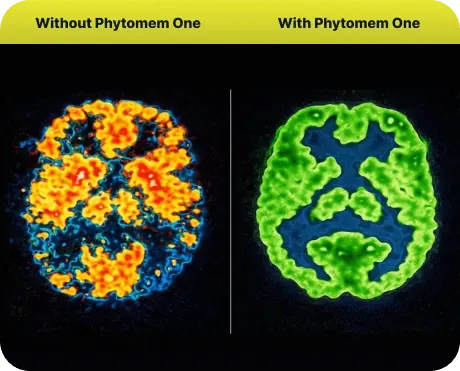
Why before-and-after images are not evidence
- There is no source: no study, no clinic and no date.
- There is no comparison group, so any change could come from time, sleep or chance.
- Colored brain images can look very different depending on how they are made and shown.
- Two pictures cannot show how many people changed, or by how much.
- The images could be drawn or picked to make a point.
A real result would come from a trial with a placebo group, a named method and published numbers. That has not been done for this tablet.
Judge
How can you judge Phytomem benefits for yourself?
Set up a fair personal test before your first tablet. A few notes now make the day-60 decision much easier.
Write down a starting point
Note two or three everyday things you want to improve, such as finding words or staying on a task. Rate each from 1 to 10.
Keep the rest of life steady
Try not to change sleep, coffee or other supplements at the same time, or you will not know what helped.
Take one tablet a day with food
Use the same meal each day. More tablets will not speed anything up.
Re-rate every two weeks
Use the same scale. Small, steady changes are easier to see on paper than in memory.
Decide before day 60
The refund window closes 60 days from purchase. If you notice nothing worth the price, ask for a refund in time.
A week-by-week guide is on the Phytomem results timeline page, and refund steps are on the guarantee page.
FAQ
Phytomem benefits FAQ
What are the main benefits of Phytomem?
The label claims support for memory, focus and clarity. These are structure-function claims; the tablet itself has not been tested in a published study.
Can Phytomem treat dementia or Alzheimer's disease?
No. It is a dietary supplement, not a treatment. Anyone with memory problems that affect daily life should see a doctor.
Which Phytomem ingredient has the best memory evidence?
Saffron. Four small trials in people with mild cognitive impairment or Alzheimer's found some benefit, but the evidence was rated low.
Is the Phytomem brain scan image real?
It is a brand graphic with no study, method or date behind it. Treat it as advertising, not proof.
Will Phytomem help a healthy adult focus better?
Nobody can say. Most ingredient studies were in people with a condition, and none tested focus with this tablet. A personal trial within the refund window is the fair test.
What does the asterisk after Memory, Focus and Clarity mean?
It points to the FDA statement that the claims have not been evaluated and that the product is not meant to diagnose, treat, cure or prevent any disease.
Wondering whether it suits you or a parent? See who Phytomem is for.