Official product information
How Does Phytomem Work? The Idea Behind the Formula
Quick answer
Phytomem combines one memory herb with ingredients studied for blood sugar, insulin and weight.
Saffron was tested in small memory trials, berberine and olive leaf in blood sugar and insulin studies, and fucoxanthin and fucoidan mostly in weight studies.
Idea
What is the basic idea behind Phytomem?
Phytomem mixes one herb with memory research and several ingredients studied for blood sugar, insulin and body weight. The idea is that a steady body may support a clear head, but that idea has not been tested with this tablet.
The brand's sales lines say the formula is "Built for lasting mental clarity, recall, and resilience" and that it can "Support your neurons, neural pathways, and cognitive function". Those are marketing words, not study results.
Looking at the ten names, they fall into four rough groups. Each group has its own research, done on single ingredients at known doses.
- A memory herb: saffron extract
- Blood sugar and insulin: berberine, olive leaf, Ceylon cinnamon and banaba
- Seaweed compounds: fucoxanthin and fucoidan
- Weight-study extracts and a sweetener: kudzu flower, Morosil and xylitol
Saffron
How is saffron thought to help memory?
Saffron is the one ingredient here that was tested on memory in people. A pooled look at four small trials found it did better than placebo on some memory and thinking scores.
Those trials enrolled 203 people with mild cognitive impairment or Alzheimer's disease, not healthy adults. Most used 30 mg of saffron extract a day. Saffron did about as well as two prescription memory drugs, but the authors rated the evidence as low (Ayati et al., 2020).
Saffron is also sold for mood. We have not reviewed a mood trial for this site, so we make no mood claim for it here.
Berberine
Why is berberine, a blood sugar compound, in a memory tablet?
The brand does not say, but its "Type 3 Diabetes" heading points to a link between blood sugar and brain health. Berberine is well studied for blood sugar, not for memory.
In 37 trials with 3,048 people with type 2 diabetes, berberine lowered fasting blood sugar and HbA1c, mostly at 0.9 to 2.4 grams a day (Chen et al., 2022). The only thinking-related trial we found was in people with schizophrenia; attention and speed scores improved, but memory did not (Pu et al., 2023).
So the path is indirect. Berberine may help blood sugar in people with diabetes, and nobody has shown that this turns into better memory from a supplement.
Olive
What does olive leaf have to do with insulin?
Olive leaf extract was tested on how well the body responds to insulin. In one trial, it helped, and that is the main reason it sits in a formula like this.
In 45 overweight middle-aged men, 51 mg of oleuropein a day for 12 weeks improved insulin sensitivity by about 15 percent versus placebo. Blood pressure and cholesterol did not change (de Bock et al., 2013).
One trial in mild Alzheimer's disease gave a daily olive leaf drink for six months. One memory score held steadier, but the study had no placebo and only 23 people finished (Loukou et al., 2024). It is a lead, not an answer.
Seaweed
What are the seaweed compounds meant to do?
Fucoxanthin and fucoidan both come from brown seaweed. Their human research is thin, and most of it is not about memory.
| Compound | What it is | Human research | Memory evidence |
|---|---|---|---|
| Fucoxanthin | The orange-brown pigment in kelp | 3 mg a day for 4 weeks lowered weight and belly fat (Hitoe and Shimoda, 2017) | One 12-week trial in 43 older adults, using a microalgae source (Yoo et al., 2024) |
| Fucoidan | A sugar-like seaweed fiber | A few small studies at 1 to 4 grams a day, well tolerated (Fitton et al., 2015) | No direct human evidence (ADDF Cognitive Vitality, fucoidan) |
The one fucoxanthin memory trial had authors from the extract's maker, and most gains were not clearly bigger than placebo. Its microalgae source also differs from the kelp the brand names.
Others
Where do cinnamon and the other ingredients fit?
Cinnamon joins berberine and olive leaf on the blood sugar side of the formula. The four info-page names add two more weight-study extracts, one more blood sugar herb and a sweetener.
Ceylon cinnamon
Studied for blood sugar with unclear results. The Ceylon type holds only trace coumarin, unlike some cassia (NCCIH, cinnamon).
Corosolic acid
From banaba leaves. One 10-person study with no placebo saw lower blood sugar (Judy et al., 2003).
Kudzu flower and Morosil
Both were tested for belly fat or weight, not memory (Kamiya et al., 2012) (Briskey et al., 2022).
Xylitol
A sugar alcohol listed as a sweetener. It has no memory role, and it is toxic to dogs.
Each ingredient, with its studied dose, has its own section on the Phytomem ingredients page.
Marketing
What do "type 3 diabetes" and the microplastics claim really mean?
Both ideas come from the brand's info page, which uses the headings "Type 3 Diabetes" and "Plastic Stranglehold". Neither is a proven fact about Phytomem.
"Type 3 diabetes" is a research idea, not a diagnosis
A 2008 research review argued for using the term to describe insulin signaling problems in the Alzheimer's brain (de la Monte and Wands, 2008). Later reviews still call it a suggested term and say the link between diabetes and Alzheimer's is debated (Nguyen et al., 2020). The American Diabetes Association lists type 1, type 2, gestational and other specific types; type 3 is not among them (ADA, diabetes classification 2025).
Microplastics in the brain are real; removing them is not proven
A 2025 autopsy study found plastic particles in human brain samples, more in 2024 than in 2016. The authors said this shows a link, not that plastics cause disease (Nihart et al., 2025). The FDA says current evidence does not show that microplastic levels in food harm health (FDA, microplastics in foods).
We found no study showing that any supplement, including any ingredient in this tablet, removes microplastics from the body.
Gap
What is missing from the Phytomem story?
Two things: the amounts and a study. Without them, the ideas above describe ingredients, not the tablet you would take.
| Question | Answer |
|---|---|
| How much of each ingredient is in a tablet? | Not published |
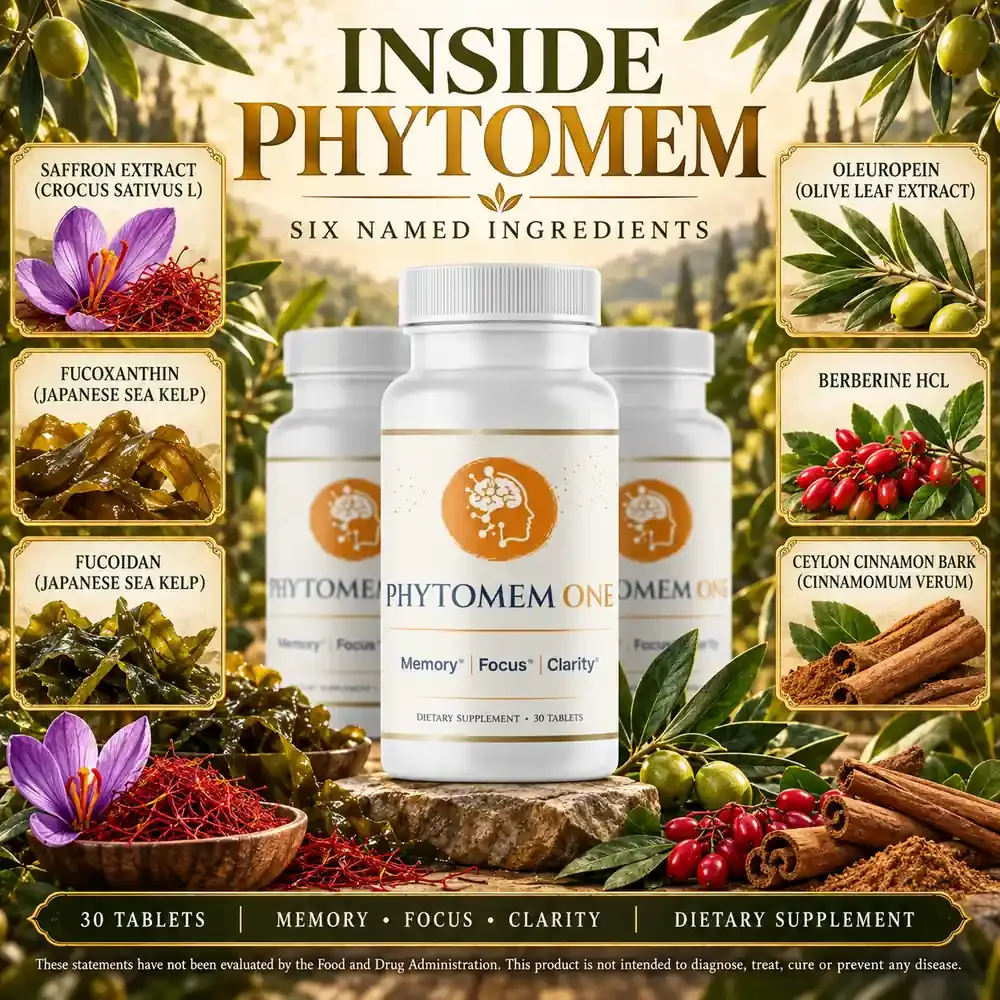
| Which of the ten names are in the tablet? | Six are on the label graphic; four more only on the info page |
| Has Phytomem been tested in a human trial? | No published study of the tablet was found |
| Do the single-ingredient doses apply? | Unknown, because no amounts are published |
| Were most ingredients tested on memory? | Only saffron and one fucoxanthin trial; the rest on blood sugar or weight |
A side-by-side of each ingredient and its evidence is in our post on Phytomem ingredients versus the research. For what the label claims, see Phytomem benefits.
FAQ
How Phytomem works: FAQ
How does Phytomem work in the brain?
Nobody knows for this tablet, since it has not been studied. Saffron has small memory trials; most other ingredients were studied for blood sugar, insulin or weight.
Does Phytomem lower blood sugar?
It makes no blood sugar claim. Berberine, olive leaf and banaba have blood sugar research, but the tablet's amounts are not published, so no effect can be predicted.
Is "type 3 diabetes" a real condition?
It is a research term for insulin problems in the Alzheimer's brain. It is not an official diagnosis and is not in the American Diabetes Association classification.
Can Phytomem remove microplastics from the brain?
No study shows that any supplement removes microplastics. Plastic particles have been found in brain tissue, but that finding does not point to a fix.
Why is a weight-loss extract in a memory formula?
Kudzu flower and Morosil were studied for weight, not memory. The brand has not said why it lists them, and they appear only on its info page.
How long before Phytomem works?
The label gives no timeline. Single-ingredient trials ran for weeks to months, and the 60-day refund window is the practical point to decide.
Before you start, read the Phytomem side effects page, which lists who should check with a doctor.