Official product information
Phytomem Ingredients: The 10 Names Behind the Tablet
Quick answer
Phytomem lists six main ingredients on its label graphic and four more on its info page.
The six are saffron extract, fucoxanthin, fucoidan, oleuropein from olive leaf, berberine HCl and Ceylon cinnamon bark. The info page adds corosolic acid, kudzu flower, Morosil and xylitol. No amounts are published.
For the bottle label itself, see the supplement facts page.
Lists
Which ingredients does Phytomem list, and where do the names come from?
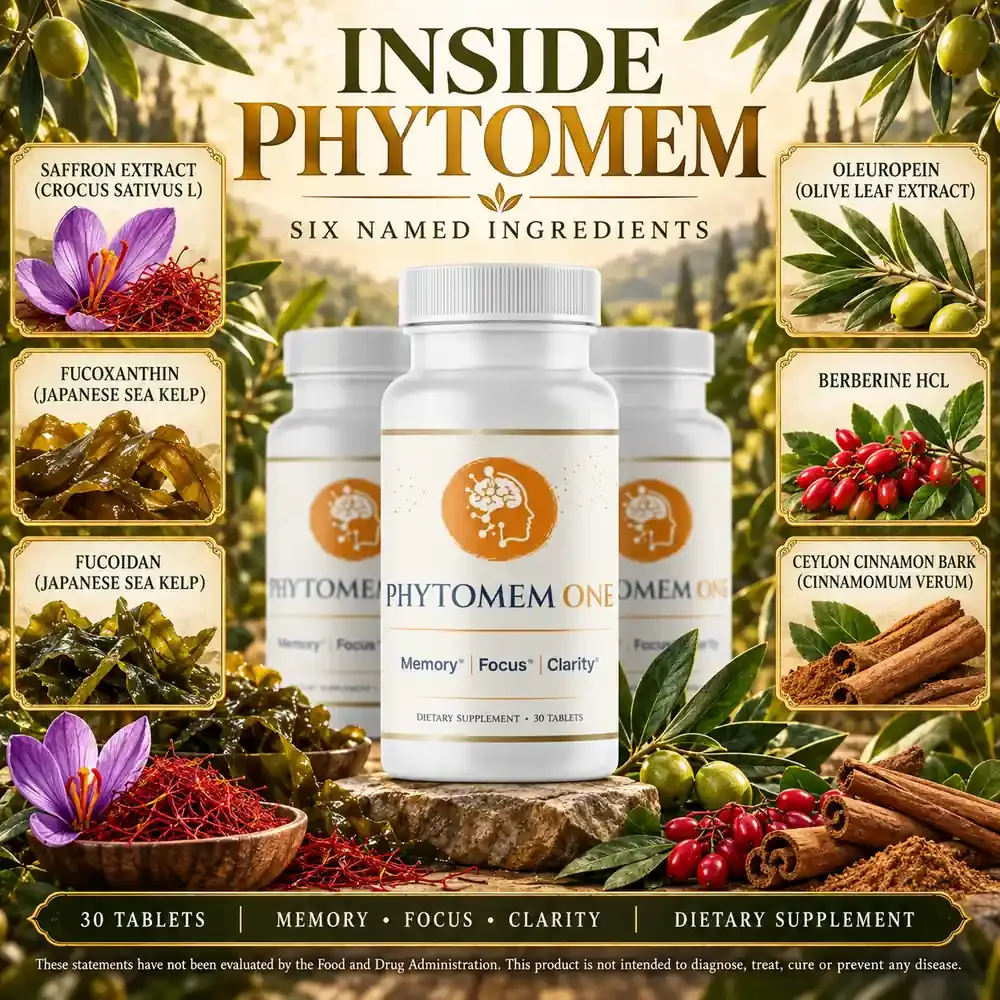
Phytomem names ingredients in two places, and the two lists are not the same length. The seller pack and the brand's own graphic name six; the brand's info page names ten.
On the seller pack and the brand graphic
- Saffron extract
- Fucoxanthin
- Fucoidan
- Oleuropein
- Berberine HCl
- Ceylon cinnamon bark
Added on the brand's info page
- Corosolic acid (from banaba leaf)
- Kudzu flower extract (Pueraria)
- Morosil (Sicilian red orange extract)
- Xylitol (a sugar alcohol sweetener)
The info page calls the product a "10-in-1" formula. Without a Supplement Facts panel, nobody outside the company can confirm which list matches the tablet.
Saffron
Saffron extract: what is it, and what did studies find?
Saffron comes from the dried threads of the Crocus sativus flower, the same costly spice used in cooking. It is the ingredient in this tablet with the most memory research behind it.
- What human studies used
- 30 mg a day of saffron extract in Alzheimer's trials, and 125 mg a day of saffron powder in one trial of mild cognitive impairment (Ayati et al., 2020)
- What they found
- Across four small trials with 203 people, saffron did better than placebo on some memory and thinking scores and did about as well as two prescription drugs.
- How sure we can be
- The review authors rated the evidence as low and said it is not enough to recommend saffron for medical use.
Food amounts of saffron are fine for most people. Doses of about 5 grams are linked to toxic effects, and saffron supplements should be avoided during pregnancy (Drugs.com, saffron monograph). The amount in one tablet is not shown.
Fucoxanthin
Fucoxanthin: what is this seaweed pigment?
Fucoxanthin is the orange-brown pigment in brown seaweeds such as kelp. The brand describes its source as Japanese sea kelp, and most of its human research is about body weight, not memory.
| Study | Who took part | Daily dose and length | What it found |
|---|---|---|---|
| (Hitoe and Shimoda, 2017) | Japanese adults with a BMI over 25 | 1 mg or 3 mg for 4 weeks | 3 mg lowered weight and belly fat; blood and urine tests showed no safety problems |
| (Yoo et al., 2024) | 43 older adults who felt their memory slipping | 8.8 mg (from a microalgae extract) for 12 weeks | Some memory tests improved, mostly over time rather than clearly versus placebo |
The memory study used fucoxanthin from microalgae, not kelp, and two authors work for the extract's maker. It says little about a kelp ingredient at an unknown dose.
Fucoidan
Fucoidan: is there human memory research?
No. Fucoidan is a sugar-like fiber from brown seaweed, and no human study of fucoidan and memory was found.
A review describes a few small human studies at 1 to 4.05 grams a day, on topics like vaccine response and tiredness during cancer care. Fucoidan was well tolerated (Fitton et al., 2015).
The Alzheimer's Drug Discovery Foundation says there is no direct human evidence linking fucoidan to dementia (ADDF Cognitive Vitality, fucoidan).
Oleuropein
Oleuropein from olive leaf: what did trials test?
Oleuropein is the main bitter compound in olive leaves. Its trials looked at blood sugar and blood pressure, plus one small trial in mild Alzheimer's.
| Study | Daily amount | Result |
|---|---|---|
| (de Bock et al., 2013) | 51 mg oleuropein with a little hydroxytyrosol, 12 weeks | In 45 overweight men, insulin sensitivity improved by about 15 percent versus placebo |
| (Ismail et al., 2021) | 500 mg or 1,000 mg olive leaf extract | Five pooled trials hinted at slightly lower blood pressure; low certainty |
| (Loukou et al., 2024) | A drink made from 21 g of dried leaves, 6 months | One memory score held steadier than with diet advice alone; no placebo, 23 finished |
Our olive leaf sources flag no specific safety warning, but the trials were small. Read the Alzheimer's trial as an early signal, not proof.
Berberine
Berberine HCl: why is a blood sugar compound in a memory tablet?
Berberine is a yellow plant compound found in goldenseal and other herbs. It is known for lowering blood sugar and has no human memory trials.
In 37 trials with 3,048 people with type 2 diabetes, berberine lowered fasting blood sugar and HbA1c. Most trials used 0.9 to 2.4 grams a day for about three months (Chen et al., 2022). A foundation review found no studies testing berberine on human thinking or dementia (ADDF Cognitive Vitality, berberine).
Cinnamon
Ceylon cinnamon bark: what does it add?
Ceylon cinnamon is the milder type often sold as "true" cinnamon. It has no memory dose in human research, and it is mostly studied for blood sugar.
A federal health agency says it is unclear whether cinnamon supplements help with diabetes. It also notes that Ceylon cinnamon (Cinnamomum verum) holds only trace amounts of coumarin, a compound found at high levels in some cassia cinnamon that could be a problem for people with liver disease (NCCIH, cinnamon).
Doses under 6 grams a day of cinnamon supplement do not appear to pose a health risk, per the same page.
Extras
What are the four extra names on the info page?
These four appear only on the brand's info page. Three were studied for blood sugar or weight, one is a sweetener, and none has a human memory study.
Corosolic acid
A compound from banaba leaves. One 10-person study with no placebo gave 16 to 48 mg of extract a day and saw lower blood sugar (Judy et al., 2003). One person with weak kidneys had a serious kidney injury after taking it (Zheng et al., 2010).
Kudzu flower extract
In 81 Japanese adults with obesity, 200 or 300 mg a day for 12 weeks lowered belly fat versus placebo. Memory was not studied (Kamiya et al., 2012).
Morosil
A branded extract of Sicilian Moro oranges. At 400 mg a day for 6 months, people lost more weight than on placebo. The extract's maker paid for the study (Briskey et al., 2022).
Xylitol
A sugar alcohol used for sweetness. In people, gut upset showed up at 35 to 50 grams in one sitting (Storey et al., 2007). In dogs, it can drop blood sugar fast (FDA, xylitol and dogs). Keep the bottle away from pets.
Dose check
Can you compare Phytomem doses with the studies?
No. Every bar below is empty because Phytomem publishes no amount for any of its ten names. The studied doses are here so you can check a panel if one appears.
Label: not published. Studied: 30 mg a day (Alzheimer's trials). (Ayati et al., 2020)
Label: not published. Studied: 1-3 mg a day (weight); 8.8 mg in one memory trial. (Hitoe and Shimoda, 2017) (Yoo et al., 2024)
Label: not published. Studied: no human memory dose. (Fitton et al., 2015)
Label: not published. Studied: 51 mg oleuropein; 500-1,000 mg extract. (de Bock et al., 2013) (Ismail et al., 2021)
Label: not published. Studied: 900-2,400 mg a day (blood sugar). (Chen et al., 2022)
Label: not published. Studied: doses vary; no memory dose. (NCCIH, cinnamon)
Label: not published. Studied: 16-48 mg banaba extract (tiny study). (Judy et al., 2003)
Label: not published. Studied: 200-300 mg a day (belly fat). (Kamiya et al., 2012)
Label: not published. Studied: 400 mg a day (weight). (Briskey et al., 2022)
Label: not published. Studied: sweetener; gut upset at 35-50 g. (Storey et al., 2007)
What a real panel would show, and what is missing today, is set out on the Phytomem Supplement Facts page.
Summary
All ten Phytomem ingredient names at a glance
Each row shows a name, its type and which list names it. Note the last column.
| Ingredient | Type | Seller pack and graphic | Info page | Amount per tablet |
|---|---|---|---|---|
| Saffron extract | Botanical | Yes | Yes | not published |
| Fucoxanthin | Seaweed compound | Yes | Yes | not published |
| Fucoidan | Seaweed compound | Yes | Yes | not published |
| Oleuropein | Botanical | Yes | Yes | not published |
| Berberine HCl | Plant compound | Yes | Yes | not published |
| Ceylon cinnamon bark | Botanical | Yes | Yes | not published |
| Corosolic acid | Plant compound | No | Yes | not published |
| Kudzu flower extract | Botanical | No | Yes | not published |
| Morosil | Fruit extract | No | Yes | not published |
| Xylitol | Sweetener | No | Yes | not published |
For the ideas behind this mix, read how Phytomem is meant to work. For a deeper look at the saffron trials, see saffron and memory, explained.
FAQ
Phytomem ingredients FAQ
What are the main ingredients in Phytomem?
The seller pack and brand graphic name six: saffron extract, fucoxanthin, fucoidan, oleuropein from olive leaf, berberine HCl and Ceylon cinnamon bark.
Why does the info page list ten ingredients?
The info page adds corosolic acid, kudzu flower, Morosil and xylitol and calls it 10-in-1. With no panel, the final list cannot be confirmed.
How much saffron is in Phytomem?
It is not published. Memory trials used 30 mg a day of saffron extract, but nobody can compare the tablet with that.
Does Phytomem contain caffeine or stimulants?
Caffeine is not on either list, and none of the ten names is a stimulant. Without a full panel, that cannot be confirmed.
Is there anything in Phytomem that is unsafe for pets?
Yes. The info page lists xylitol, which is toxic to dogs. Store the bottle where a dog cannot reach it.
Has Phytomem itself been tested in a study?
No study of the finished tablet has been published. Every study on this page tested one ingredient on its own.
Possible side effects of each ingredient are covered on the Phytomem side effects page.