Official product information
Phytomem Testing and Quality: What Each Seal Does and Does Not Prove
Quick answer
Phytomem art carries eleven seals, from GMP and made in USA to gluten-free and Doctor Formulated. They are the brand's own images. We found no named certifier, no named doctor and no public lab report behind them. The info page adds "certified facility" and "non-GMO, stimulant-free, 100% natural", without saying who checked.
At a glance
What can be confirmed about Phytomem testing and quality?
Very little beyond the brand's own images. Phytomem art shows eleven seals, and the brand's info page says the tablets are made in a "certified facility" and are "non-GMO, stimulant-free, 100% natural". No certifier, factory, lab or doctor is named anywhere we could find.
- Seals in the brand's art
- 11, listed one by one below
- Who issued the seals
- not published
- Factory name and location
- not published
- Public lab report (certificate of analysis)
- None found
- Other ingredients, such as tablet binders
- not published
- Info page wording
- Certified facility; non-GMO, stimulant-free, 100% natural
- Reference labels in the seller pack
- Lot PHY-26/GO-5523, certificate PHY-5523-26-GO
- FDA approval
- Not possible: the FDA does not approve supplements
Factory seals
The manufacturing seals: GMP, registered facility and made in USA
Three seals describe the place where the tablets are made. All three are about a building and its paperwork, and none of them tests what is inside a bottle.
GMP seal
In general: Good manufacturing practice means rules for clean rooms, staff training, records and batch checks. US supplement makers are expected to follow these rules anyway, so the seal marks a baseline, not an extra.
What we could confirm: Only the seal itself. No audit body, audit date or facility name is published.
Registered facility seal
In general: Food and supplement plants register with the FDA so the agency knows where they are. Registration is a listing, not an inspection result and not an approval of any product.
What we could confirm: The info page says "certified facility" but does not say who certified it or for what.
Made in USA seal
In general: A made-in-USA claim says where a product was put together. It says nothing about where each raw ingredient, such as saffron or kelp, was grown.
What we could confirm: The label text we have does not state a country, and no manufacturer or distributor is named.
Ingredient seals
The ingredient seals: GMO-free, natural, gluten-free, dairy-free and vegetarian
Five seals make promises about what is, or is not, in the tablet. Each one depends on the full ingredient list, including binders and coatings, and that list is not published.
GMO-free seal
In general: Says no ingredient comes from a genetically modified crop. Outside programs exist to check this claim, and they print their own mark.
What we could confirm: The info page repeats "non-GMO". No outside program's mark or name appears.
100% natural seal
In general: "Natural" has no strict legal meaning for supplements. Makers use it in different ways, and nobody checks it for them.
What we could confirm: The info page says "100% natural". Xylitol, listed there as a sweetener, is a sugar alcohol usually made by processing plant fibers.
Gluten-free seal
In general: Means no wheat, barley or rye, and for people with celiac disease, very low gluten from shared machines too.
What we could confirm: Cannot be checked. Tablet fillers and binders are not published.
Dairy-free seal
In general: Means no milk-based ingredients. Lactose is a common tablet filler, so this seal matters for tablets.
What we could confirm: Cannot be checked for the same reason: the other ingredients are not published.

Vegetarian seal
In general: Means no meat, fish or gelatin. Fucoxanthin and fucoidan come from seaweed, not from animals.
What we could confirm: Cannot be checked. Coatings and binders, where animal products sometimes hide, are not listed.
If allergies or diet rules matter to you, ask the order desk for the full other-ingredients list before you buy. Our Phytomem Supplement Facts page tracks what has and has not been published.
Promise seals
Doctor Formulated, satisfaction guarantee and the 60-day roundel
The last three seals are about who designed the formula and what happens if you are not happy. Only one of them is backed by written terms we could read.

Doctor Formulated seal
In general, this seal says a licensed doctor helped design the formula. A trustworthy version names the doctor and says what their training is.
We found no name, no credentials and no statement from any doctor. Treat the seal as a marketing line until a name is published.
Satisfaction guarantee badge and 60-day roundel

Both seals promise your money back. The terms give you 60 days from purchase, and you pay the return postage.
This is a refund promise, not a quality test. Full steps are on the Phytomem guarantee page.
Lab photo
Is the lab photo proof that Phytomem is tested?
No. The lab picture is stock-style art, and nothing in it links to a test of this product. It shows a mood, not a result.

A real test of a supplement names the lab, the lot it tested, the date and what it looked for. That usually means identity, strength, and checks for metals and germs.
The seller pack gives lot PHY-26/GO-5523 and certificate PHY-5523-26-GO. These are reference labels, not lab proof, since no report with those numbers has been published.
You can read how to use them on the Phytomem batch check page.
Brain graphic
Why the brain-scan graphic is not a study
The two colored brain images are a brand graphic, and no study stands behind them. They are labeled "Without Phytomem One" and "With Phytomem One", and that label is all the information given.
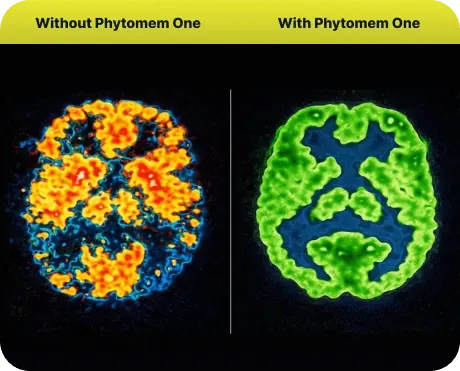
- Real brain imaging research says who was scanned, with what machine, and how long they took the product.
- Colors on a scan depend on the scan type and the software settings. Warm colors are not "worse" by themselves.
- A before-and-after pair needs the same person, scanned the same way, weeks or months apart. Nothing here shows that.
- No trial of the Phytomem tablet has been published, so no scan of its effect exists to show.
Fda
Does the FDA approve or test Phytomem?
No. The FDA does not have the power to approve dietary supplements before they are sold (FDA, dietary supplement Q&A). The maker is responsible for safety and for the label, and the FDA steps in after problems appear.
That is why the bottle carries the standard notice that its statements have not been evaluated by the FDA. A product sold to treat, prevent or cure a disease counts as a drug under the law, and the FDA has sent warning letters to supplement sellers making Alzheimer's claims (FDA, unproven Alzheimer's products).
Summary
Phytomem seals and quality claims: summary table
Here is every seal and quality image on one screen. The last column is the honest bottom line for each.
| Seal or image | What it usually means | What we could confirm |
|---|---|---|
| GMP | Factory follows manufacturing rules | The image only |
| Registered FDA Facility | Factory is listed with the FDA | The image and the info page's "certified facility" |
| Manufacture in USA | Assembled in the US | The image only; no factory named |
| GMO-free | No genetically modified sources | The image and "non-GMO" on the info page |
| 100% natural | A loose marketing word | The image and the info page wording |
| Naturally gluten-free | No gluten grains | Cannot check; binders not published |
| Dairy-free | No milk ingredients | Cannot check; fillers not published |
| Vegetarian | No animal ingredients | Cannot check; coating not published |
| Doctor Formulated | A doctor helped design it | No doctor named |
| 100% satisfaction guarantee | Refund if unhappy | Written 60-day terms exist |
| 60 days money back roundel | Refund window length | Matches the written terms |
| Lab workers photo | Suggests testing | Stock-style art, not proof |
| Brain-scan graphic | Suggests a brain change | No study behind it |
| Certificate of analysis | Lab results for a lot | None published |
Coa
No public certificate of analysis: what you can do
A certificate of analysis is a lab report for one lot, and none is public for Phytomem. You can still take a few simple steps to protect yourself.
Ask for the report
Call +1 (302) 200-3480 or write [email protected] and ask whether a lab report exists for your lot. A named lab and a test date are what to look for.
Read the base of the bottle
Note the lot number and best-before date when the bottle shows them. Keep them with your order email.
Ask about other ingredients
If you avoid gluten, dairy or animal products, ask for the binder and coating list in writing.
Check the seal under the cap
Do not use a bottle whose seal is broken or missing. Report it to the order desk.
Questions for this website, not about orders, go to [email protected]. All contact routes are on the contact page.