Phytomem Blog
Is the Plastic Stranglehold and Type 3 Diabetes Story Behind Phytomem One True?
Quick answer
Parts are real and parts are stretched. Plastic particles were found in human brain samples, and type 3 diabetes is a research term. But it is not an official diagnosis, no study shows any supplement removes plastics, and the brand's brain graphic is not a study. No study of Phytomem One exists.
Medically reviewed by Dr. Madeeha Shahzadi, MD PulmonologistReviewed

The Phytomem One sales page tells a vivid story. It speaks of a plastic stranglehold on the brain and of type 3 diabetes, and it offers a pair of colored brain pictures. Stories like this one spread because they contain a kernel of truth.
This fact check takes each piece in turn. We use only sources named on this site, we say what they support, and we say where the sales story runs ahead of them.
Key facts
Key facts: what should you know first?
- Plastic particles were found in human brain samples in a 2025 autopsy study, more in 2024 than in 2016. The authors said it shows a link, not a cause.
- No study shows that any supplement removes plastics from the body.
- Type 3 diabetes is a term proposed in 2008. Later reviews call it a suggested term, and the American Diabetes Association does not list it.
- The FDA says current evidence does not show that microplastic levels in food harm health.
- The Without and With Phytomem One brain graphic names no person, scan type, date, dose or study.
- No published study of the Phytomem One tablet exists.
Plastics
Are there really plastic particles in the human brain?
Yes, and that part is not made up. A 2025 study of brain samples taken after death found plastic particles in human brain tissue, with higher levels in samples from 2024 than from 2016 (Nihart et al., 2025). The authors were careful. They said the finding shows a link and does not prove that plastics cause disease.
The FDA takes a similar cautious line on food. Its page says current scientific evidence does not show that the levels of microplastics found in foods are a risk to human health (FDA, microplastics in foods). So the first half of the stranglehold story is a real research topic. The word stranglehold, though, goes far past what any study says.
Removing plastics
Can a supplement clear plastics out of the brain?
We found no study that shows it, for any ingredient in this tablet or any other supplement. The brand's sales page says the formula addresses the plastic stranglehold, and it cites no study for that sentence. The seller pack notes that the brand's references page lists research links without saying which claim each one supports.
Type 3 diabetes
Is type 3 diabetes a real diagnosis?
It is a real phrase, used in research, but it is not an official diagnosis. A 2008 review argued for using the term to describe insulin signaling problems in the Alzheimer's brain (de la Monte and Wands, 2008). A later review still calls it a suggested term and says the link between diabetes and Alzheimer's is debated (Nguyen et al., 2020). The American Diabetes Association lists type 1, type 2, gestational and other specific types, and type 3 is not among them (ADA, diabetes classification 2025).
| Source | What it says |
|---|---|
| (de la Monte and Wands, 2008) | Argued for the term for insulin signaling problems in the Alzheimer's brain |
| (Nguyen et al., 2020) | Calls it a suggested term; the link with diabetes is debated |
| (ADA, diabetes classification 2025) | Does not list a type 3 in its classification |
| Phytomem One sales page | Uses the heading Type 3 Diabetes as part of its story |
So the blood sugar angle is an idea, not a diagnosis. That matters because it explains why a memory tablet carries berberine, olive leaf, cinnamon and banaba, ingredients studied for blood sugar.
The graphic
Does the before-and-after brain picture prove anything?
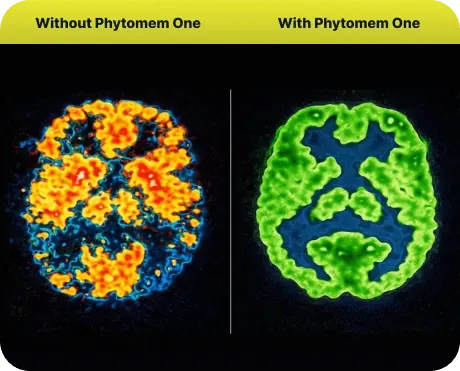
It proves nothing, because no study stands behind it. Real brain imaging research says who was scanned, on what machine and for how long they took the product. A fair before-and-after pair needs the same person, scanned the same way, weeks or months apart. Colors on a scan also depend on the scan type and the software, and warm colors are not worse by themselves.
This is also why searches for Phytomem before and after lead nowhere useful. No dated, matched photographs or scans of real users are published on this site, and none are verified.
Other claims
What about the other numbers on the sales page?
The seller pack lists several per-ingredient statements from the brand, such as fucoidan reducing oxidative stress in brain tissue by up to 40% and cinnamon improving insulin receptor sensitivity by up to 20%. The pack records that no study is cited for them on the page itself. We do not repeat them as facts.
The same pack notes that testimonials on the page are labeled as changed names, that results vary and that some video visuals may be recreated or AI-assisted. That is why this site shows no star ratings, no customer quotes and no result stories.
- Claims with a named study and a dose can be checked.
- Claims with a percentage and no study cannot.
- Claims about cures or reversal have no place on a supplement page.
What is real
So what is real, and what should you do?
Real: plastic particles have been found in brain samples. Real: type 3 diabetes is a research term. Real: berberine and olive leaf have blood sugar studies, and saffron has small memory trials (Ayati et al., 2020). Not shown: that the tablet removes plastics, treats a type 3 condition or changes a brain scan.
Phytomem One is a dietary supplement. It is not FDA approved, and the FDA has warned sellers who made Alzheimer's claims for supplements (FDA, unproven Alzheimer's products). If memory changes worry you, see a doctor, since some causes can be treated (NIA, memory problems and aging).
FAQ
Frequently asked questions
Is the plastic stranglehold claim true?
Plastic particles were found in human brain samples, but the study shows a link and not a cause. No study shows that any supplement removes them.
Is type 3 diabetes a real condition?
It is a research term proposed in 2008 for insulin problems in the Alzheimer's brain. It is not an official diagnosis in the American Diabetes Association classification.
Does Phytomem One remove microplastics?
No study shows that it or any supplement does. The sales page makes the claim without citing a study for it.
Is the brain scan graphic real evidence?
No. It is brand art labeled Without and With Phytomem One, with no person, scan type, date or study given.
Do Phytomem before and after results exist?
None are published or verified on this site. The graphic is not a before-and-after record of real users.
Has Phytomem One been tested in a human trial?
No published study of the finished tablet was found. The studies we cite tested single ingredients.
Sources
Where does this information come from?
Product facts come from the bottle label image, the seller pack and the brand pages this site checked. Studies and agency pages are linked below.
- Nihart et al., 2025
- FDA, microplastics in foods
- de la Monte and Wands, 2008
- Nguyen et al., 2020
- ADA, diabetes classification 2025
- Ayati et al., 2020
- FDA, unproven Alzheimer's products
- NIA, memory problems and aging
Related reading on this site
Our view
Our view
The sales story borrows two real research topics and joins them to a product that was never tested on either. That is a common move, and it works because each piece sounds familiar. A careful reader can enjoy the story and still ask for the study.
Our view: judge the tablet by its label, its safety notes and your own 60-day notes, and not by its pictures. If the blood sugar idea interests you, bring it to a doctor, who can test blood sugar properly instead of leaving it to a supplement.
Last updated . Written by the Phytomem Editorial Desk. Medically reviewed by Dr. Madeeha Shahzadi, MD Pulmonologist. This page is general information, not medical advice. Phytomem One is a dietary supplement. It is not FDA approved, and it does not treat or prevent any disease. Ask your own doctor about your own case.